Wednesday, 15 March 2017

16th March 2017 strike is inevitable.

We are forced to go on a day's strike on 16thMarch 2017 due to the inaction of the Government.  Seven months have lapsed still the committee has not submitted any report.
A group of ministers comprising Home Minister Shri.Raj Nath Singh,  Finance Minister Shri. Arun Jaitley  & Railway Minister Shri. Suresh Prabhu called NJCA leaders on 30/06/2016 and assured that a high power committee will be constituted to look into the matter regarding revision of wages and fitment formula. Based on the assurance, the JCM Constituent deferred the Strike action to 06th July 2016.Though our Federation appealed PJCA to continue the strike as decided on July 11 2016, it was not considered in the larger interest of Central Government employees unity.
As assured a Committee was constituted under the chairmanship of Addl. Secretary (Exp), Ministry of Finance and discussions held, the response was very much disappointing. Against this we conducted a protest week from 12th December to 19th December 2016 and submitted a memorandum to our Honourable Prime Minister through state Governors as well as in his office, there is no response till date.
On 19/01/2017 A meeting was held with the Cabinet Secretary, Government of India, wherein Staff side secretary and the president were present.
The staff side explained Cabinet secretary about various Issues of the Central Government Employees pending at the Government level.  The main issues were NPS, Minimum Wage and Fitment Formula, Allowances, Pension and enhancing  Benchmark from good to Very Good.  The Cabinet Secretary informed staff side that, Pension issues have already been referred to the Cabinet, and the report of the Committee on Allowances is likely to be submitted in the next month.  It is not certain whether there will be any revision in minimum wage and Fitment formula & arrears of allowances from 01/01/2016.
Meanwhile, on 10.02.2017 NPS committee  has called the JCM Staff Side for a second round of discussion, during  the discussion they want to discuss only notified agenda, such as (1) scrapping of NPS (2) Guaranteed Minimum pension to NPS Pensioners  ie; 50% of the last pay drawn should be guaranteed by the Government as minimum pension, even if the returns from annuity insurance scheme amount is less than 50%.
Unfortunately, the main demand of Exemption of Central Govt. Employees from the purview of NPS, was not included in the agenda.
With regard to GDS,  our Federation and NUGDS warmly welcome the welfare measures which were recommended by Sri.Kamalesh Chandra committee. At the same time, our Federation strongly oppose the non‘Removal of 3 -A (I) of GDS Conduct & Engagement Rules, 2011.
Regarding Casual Labours, the revised wages and its arrears have not been paid in many Circles. 
In view of the above, we cannot remain silent just conducting a protest week and Dharna. As we have to show a strong protest against the attitude of the Government, the FNPO affiliates decided to go on a day`s strike on March 16th, 2017. 
We appeal all our colleagues to organise the one-day strike and make it a thundering success.

Directorate Letter to SG FNPO regarding presentation on views on GDS committee report


Directorate Letter to SG FNPO regarding presentation on views on GDS committee report - Click here to view

DOP's reply regarding our Federation affiliated union demands


DOP's reply regarding our Federation affiliated union demands - Click here to view

Monday, 13 March 2017

Saturday, 11 March 2017

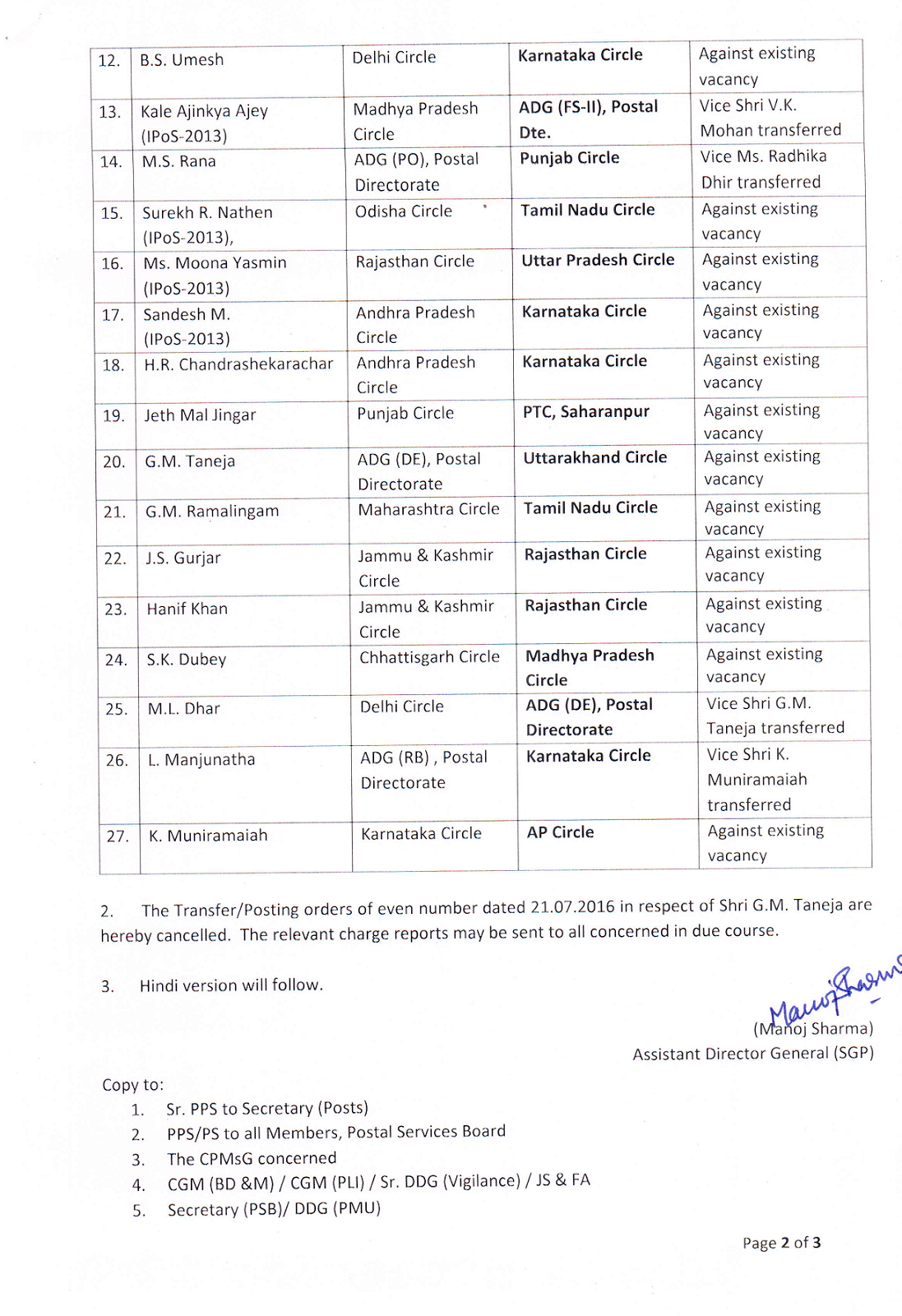
Promotion/ Transfer / Posting in the grade of Asst. Accounts officer of Indian


7th CPC Committee report not yet submitted to the Government- Loksabha Q&A

GOVERNMENT OF INDIA
MINISTRY OF FINANCE
Department of Expenditure
LOK SABHA
UNSTARRED QUESTION NO: 1778
ANSWERED ON: 10.03.2017
Committee on Allowances of Seventh Central Pay Commission
SULTAN AHMED
DUSHYANT CHAUTALA
Will the Minister of
FINANCE be pleased to state:-
(a) whether the Government has set up a Committee to examine the various allowances in the light of recommendation made by the Seventh Central Pay Commission;
(b) if so, the details and terms of reference thereof;
(c) whether the said Committee on allowances has submitted its report to the Government, if so, the recommendations made by the Committee along with the follow-up action taken by the Government thereon;
(d) if not, the reasons therefor and the time by which the said report is likely to be submitted; a
(e) whether the Government proposes to give arrear of House Rent Allowance and other allowances with effect from the month of notification of implementation of Seventh Central Pay Commission, if so, the details thereof and if not, the reasons therefor?


ANSWER
MINISTER OF STATE IN THE MINISTRY OF FINANCE
(SHRI ARJUN RAM MEGHWAL)
(a) & (b): Yes. The Committee on Allowances has been constituted vide order dated 22.07.2016. The Committee is to examine the recommendations of the 7th CPC in regard to various allowances having regard to the representations made by the Staff Associations and the suggestions of the concerned Ministries/Departments and make recommendations as to whether any changes in the recommendations of the 7th CPC are warranted and if so, in what form.
(c) to (e): The Committee has not submitted its report to the Government. The deliberations of the Committee are in the final stages. Decisions on implementing the Report will be taken after the Report is submitted by the Committee.
7th CPC Loksabha Q&A

Friday, 10 March 2017

Lok Sabha passes Bill to raise maternity leave to 26 weeks; will benefit 1.8 million women

Women working in the organised sector will now be entitled to paid maternity leave of 26 weeks, up from 12 weeks, as Parliament today passed a Bill in this regard that will benefit about 1.8 million women.
The new law will apply to all establishments employing 10 or more people and the entitlement will be for only up to first two children. For third child, the entitlement will be for only 12 weeks.
The Maternity Benefit (Amendment) Bill, 2016 was passed by the Lok Sabha today, months after the Rajya Sabha approved the measure that takes India to the third position in terms of the number of weeks for maternity leave after Canada and Norway where it is 50 and 44 weeks, respectively.
Piloting amendments to the old law, Labour Minister Bandaru Dattatreya said while framing the rules, he would try to ensure that maximum benefits reach the pregnant women.
“This is my humble gift to women, a day after the world celebrated the International Women’s Day,” he said after about 4-hour debate during which some members demanded paternity benefits too, arguing that these days most of the children are born in nuclear families where both the father and the mother have to take care of the child.
The Maternity Benefit Act, 1961, protects the employment of women during the time of her maternity and entitles her full paid absence from work, to take care for her child. Among other things, the Bill provides for 12 weeks of maternity leave to a woman who legally adopts a child below three months of age and a commissioning mother (defined as a biological mother) who uses her egg to have a surrogate child.
In such cases, 12-week period of maternity leave will be calculated from the date the child is handed over to the adoptive or commissioning mother.
The Bill also requires every establishment with 50 or more employees to provide creche facilities within a prescribed distance. The woman will be allowed four visits to the creche in a day. This will include her interval for rest.

Thursday, 9 March 2017

General Provident Fund (GPF) To Be Paid Within 15 Days Now

In a good news for about 50 lakh central government employees, the norms for withdrawal of General Provident Fund (GPF) have been relaxed, the new norms will enable them to receive payments within 15 days.
Employees can now withdraw the fund for select purposes after completing 10 years of service, as against the previous stipulation of minimum 15 years of service.
The GPF can be taken for education – including primary, secondary and higher education, covering all streams and institutions. Earlier, a subscriber could withdraw GPF only for beyond the high school stage.
“Some amendments have been made (in rules) from time to time to address the concerns raised by the subscribers. However, the provisions, largely remain restrictive. There is a felt need to liberalise provisions, raise limits and simplify the procedure,” the DoPT Office Memorandum said.
The provisions in the rules have been reviewed and it has now been decided to permit withdrawals from the fund by the subscriber for obligatory expenses viz. betrothal (engagement), marriage, funerals, or other ceremonies of self or family members and dependants, besides illness of self, family members or dependants, it said.
“It has been decided to permit withdrawal of up to twelve months pay or three-fourth of the amount standing at credit, whichever is less. For illness, the withdrawal may be allowed up to 90 per cent of the amount standing at credit of the subscriber. A subscriber withdrawal after completion of ten years of service,” the ministry said in an order to all central government departments.
The GPF can be withdrawn for purchase of consumer durables too.
Existing rules do not give any time limit or sanction and payment of withdrawal amount.
“Therefore, it has been decided to prescribe a maximum time limit of fifteen days for sanction and payment of withdrawal from the fund. In case of emergencies like illness etc., the time limit maybe restricted to seven days,” the order said.
Source: PTI

Government to announce 7th CPC Allowances in Parliament session

Expectations are rising that the government may soon announce a hike in allowance as part of the Seventh Pay Commission awards. The second half of the Budget session starts from March 9. Union officials had held final round of talks on February 22 with members of the Ashok Lavasa panel on Seventh Pay Commission allowances, according to Shiv Gopal Mishra, the convenor of National Joint Council of Action (NJCA), a joint body of unions representing central government employees. Some union officials said that the panel on Seventh Pay Commission allowances has already submitted its report.The unions have demanded HRA at the rate of 30 per cent, 20 per cent and 10 per cent. The Seventh Pay Commission had recommended that HRA be paid at the rate of 24 per cent, 16 per cent and 8 per cent of the new Basic Pay, depending on type of cities.


The Seventh Pay Commission had also recommended that the rate of HRA be revised to 27 per cent, 18 per cent and 9 per cent respectively when DA crosses 50 per cent, and further revised to 30 per cent, 20 per cent and 10 per cent when DA crosses 100 per cent.
The panel headed by Finance Secretary Ashok Lavasa had reviewed Seventh Pay Commission allowances. The government had in June accepted the recommendation of Justice AK Mathur-headed Seventh Pay Commission in respect of the hike in basic pay and pension but its suggestions relating to allowances were referred to the committee. The Seventh Pay Commission had examined a total of 196 existing allowances and, by way of rationalisation, recommended abolition of 51 allowances and subsuming of 37 allowances.
The committee on allowances was initially given a time of four months to submit its report to the finance minister. Allowances form a significant chunk of government employees’ salary.

Source : Profit.ndtv

Transfer/Postings/Re-allotments of the Indian Postal Service (IPoS) Group A


Wednesday, 8 March 2017

வங்கிகளின் சேவை வரிகளால் வாடிக்கையாளர்கள் பாதிப்பு: வரப்பிரசாதமாக திகழும் அஞ்சலக சேமிப்புக் கணக்கு


குறைந்தபட்ச தொகை ரூ.50; கட்டணமில்லா பரிவர்த்தனை

வங்கிகளில் 4 முறைக்கு மேல் பண பரிவர்த்தனை செய்தால் சேவை வரி வசூலிக்கப்படும் என அறிவிக்கப்பட்டுள்ளது. மேலும் குறைந்தபட்ச வைப்புத் தொகையும் அதிகரிக்கப்பட்டுள்ளது. இதனால் சாதாரண மக்கள் பாதிக்கும் நிலை ஏற்பட்டுள்ளது. இந்நிலையில் அஞ்சலக சேமிப்புக் கணக்கு ஒரு வரப்பிரசாதமாக உள்ளது.

மத்திய அரசின் பணமதிப்பு நீக்க நடவடிக்கைக்கு பிறகு பணமில்லா பரிவர்த்தனையை ஊக்குவிக்க பல்வேறு நடவடிக்கைகள் எடுக்கப்பட்டு வருகின்றன. இதை தனியார் வங்கிகள் தங்களுக்கு சாதகமாக பயன்படுத்திக்கொள்ள தொடங்கியுள்ளன. இதன் விளை வாக புதிய தலைமுறை தனியார் வங்கிகளான எச்டிஎப்சி, ஐசிஐசிஐ மற்றும் ஆக்சிஸ் வங்கிகள் மாதம் ஒன்றுக்கு 4 முறைக்கு மேல் செய்யப்படும் ரொக்கப் பணப் பரிவர்த்தனைக்கு ஒவ்வொரு முறையும் ரூ.150 கட்டணம் விதித்து அதை உடனடியாக நடை முறைப்படுத்தவும் செய்துவிட்டன.

இந்நிலையில், பொதுத்துறை வங்கியான பாரத ஸ்டேட் வங்கி ஒருபடி மேலே போய் 3 முறைக்கு மேல் செய்யப்படும் ஒவ்வொரு பரிவர்த்தனைக்கும் ரூ.50 கட்டணம் வசூலிக்கப்படும். அத்துடன், பெரு நகரங்களில் கணக்கு வைத்திருப் பவர்கள் குறைந்தபட்சம் ரூ.5,000, நகர்ப்புறங்களில் கணக்கு வைத் திருப்பவர்கள் ரூ.3,000, சிறு நகரங் களில் கணக்கு வைத்திருப்பவர்கள் ரூ.2,000 மற்றும் கிராமப்புறங்களில் கணக்கு வைத்திருப்பவர்கள் ரூ.1,000 குறைந்தபட்ச தொகையாக வைத்திருக்க வேண்டும்.

இல்லையெனில், எவ்வளவு தொகை குறைவாக உள்ளதோ அந்தத் தொகைக்கு ஏற்ப அபராதம் விதிக்கப்படும். இதன்படி, குறைந்தபட்ச தொகையில் 75 சதவீதம் பற்றாக்குறை இருந்தால் ரூ.100 செலுத்த வேண்டும். 50 சதவீதம் பற்றாக்குறை இருந்தால் ரூ.75-ம், 50 சதவீதத்துக்கு கீழ் இருந்தால் ரூ.50-ம் செலுத்த வேண்டும். இவற்றுடன் சேவை வரியும் செலுத்த வேண்டும்.
கிராமப் புறங்களில் உள்ள வங்கிக் கணக்கில் குறைந்தபட்ச தொகை இல்லையெனில் ரூ.20 முதல் ரூ.50 வரை அபராதம் மற்றும் சேவை வரி செலுத்த வேண்டும் என பாரத ஸ்டேட் வங்கி அறிவித் துள்ளது. வரும் ஏப்ரல் 1-ம் தேதி முதல் இது நடைமுறைக்கு வர உள்ளதாக இவ்வங்கி தெரிவித் துள்ளது. இந்த அறிவிப்பு வங்கி வாடிக்கையாளர்களிடையே பெரும் அதிர்ச்சியை ஏற்படுத்தி யுள்ளது.

ஆனால், அஞ்சலக சேமிப்பு கணக்கு குறித்த விழிப்புணர்வு பொது மக்களிடம் இல்லாமல் உள்ளது. அஞ்சலக சேமிப்புத் திட்டத்தில் எத்தனை முறை வேண்டு மானாலும் கட்டணமில்லாமல் பணப் பரிவர்த்தனை மேற்கொள்ள லாம். மேலும், சேமிப்புக் கணக் கில் குறைந்தபட்சம் ரூ.50 இருந்தால் போதும்.
இதுகுறித்து, தலைமை அஞ்சல்துறை தலைவர் எம்.சம்பத் ‘தி இந்து’விடம் கூறியதாவது:

வங்கிகளில் தற்போது 4 முறைக்கு மேல் பரிவர்த்தனை மேற்கொண்டால் கூடுதல் கட்டணம் வசூலிக்க முடிவு செய்யப்பட் டுள்ளது. இதனால் வங்கி வாடிக்கை யாளர்களுக்கு பாதிப்பு ஏற்படும் நிலை உள்ளது. எனவே அவர்கள் இப்பிரச்சினையில் இருந்து விடுபட அஞ்சல் நிலையங்களில் சேமிப்புக் கணக்குத் தொடங்க லாம். இந்த சேமிப்புக் கணக்கில் குறைந்தபட்சம் ரூ.50 இருந்தால் போதும். அதேபோல், அஞ்சலகங் களில் சேமிப்புக் கணக்குத் தொடங்கி ஏடிஎம் கார்டு பெற்று அனைத்து வங்கி ஏடிஎம்களிலும் எத்தனை முறை வேண்டுமானா லும் கட்டணமில்லாமல் பணம் எடுக்கலாம். அஞ்சல் நிலையங் களில் சேமிப்புக் கணக்குத் தொடங்குவது மிகவும் எளிது. சேமிப்புக் கணக்குத் தொடங்க புகைப்படம் மற்றும் முகவரி சான்றை அளித்தால் போதுமானது.

தமிழகம் முழுவதும் 2,612 அஞ்சல் நிலையங்கள் உள்ளன. இதில், தலைமை அஞ்சல் நிலை யங்கள் 94-ம், துணை அஞ்சல் நிலையங்கள் கிராமப் பகுதியில் 1,312-ம், நகர்ப்புற பகுதியில் 1,206-ம் என மொத்தம் 2,518 உள்ளன. இதைத் தவிர பகுதிநேர மாக செயல்படக் கூடிய கிளை அஞ்சல் நிலையங்கள் கிராமப்புற பகுதியில் 8,947-ம், நகர்ப்புற பகுதியில் 331-ம் உள்ளன.

இதைத் தவிர, நாடு முழுவதும் 2,513 அஞ்சல் நிலையங்களில் ‘கோர் பேங்கிங்’ வசதி உள்ளது. தமிழகம் முழுவதும் அஞ்சல் நிலைய ஏடிஎம்கள் 97 உள்ளன. எனவே பொதுமக்கள் அஞ்சலகங் களில் சேமிப்புக் கணக்குத் தொடங்கி எவ்வித கட்டணமும் இன்றி தங்களது பணப்பரிவர்த் தனையை எத்தனை முறை வேண்டு மானாலும் மேற்கொள்ளலாம்.

இவ்வாறு சம்பத் கூறினார்.

General Financial Rules,2017

General Financial Rules, 2017


To view please Click Here.

GPF withdrawals Limits and Conditions are liberalised

 No.3/2/2017-P&PW(F)(ii)

Ministry of Personnel, PG & Pensions
Department of Pension & Pensioners’ Welfare
Desk-F3rd Floor, Lok Nayak Bhavan,

Khan Market, New Delhi-11 0003
Dated the 7th March, 2017.
OFFICE MEMORANDUM
Subject: Amendment to the provisions of General Provident Fund (Central Service )Rules 1960- liberalization of provisions for withdrawals from the Fund by the subscribers – regarding.
The General Provident Fund (Central Service )Rules came into force in 1960 and Rule 15 of the said rules provide for withdrawals by the subscribers. Some amendments have been made from time to time to address the concerns raised by the subscribers. However, the provisions, largely remain restrictive. There is a felt need to liberalize provisions, raise limits and simplify the procedure.
2. The provisions in the rules have been reviewed and it has now been decided to permit withdrawals from the fund by the subscriber for the following purposes:

(i) Education – This will include primary, secondary and higher education, covering all streams and institutions,
(ii) Obligatory Expenses viz. betrothal, marriage, funerals, or other ceremonies of self or family members and dependants,
(iii) Illness of self, family members or dependants,
(iv) Purchase of consumer durables.
3. It has been decided to permit withdrawal of upto twelve months pay or three-fourth of the amount standing at credit, whichever is less. For illness, the withdrawal may be allowed upto 90% of the amount standing at credit of the subscriber. A subscriber may seek withdrawal after completion of ten years of service.

(v) Housing including building or acquiring a suitable-house or a ready-built flat for his-residence,
(vi) Repayment of outstanding housing loan,
(vii) Purchase of house site for building a house,
(viii) Constructing a house on a site acquired,
(ix) Reconstructing or making additions on a house already acquired,
(x) Renovating, additions or alterations of ancestral house.
4. A subscriber may be allowed to withdraw upto ninety percent of the amount standing at credit for the above purposes. It is also decided do away with the present instructions which lay down that subsequent to the sale of house for which GPF withdrawal has been availed, the amount. withdrawn has to be deposited back. GPF withdrawal for housing purpose will no longer be linked with the limits prescribed under HBA rules. A subscriber may be permitted to avail the facility at any time during his service.

(xi) Purchase of motor car/motor cycle/ scooter etc. or repayment of loan already taken for the purpose,
(xii) Extensive repairs /overhauling of motor car,
(xiii)Making deposit to book a motor car/motor cycle/scoter, moped etc.
5. A subscriber may be permitted to withdraw three- fourth of the amount standing at credit or cost of the vehicle, whichever is less for the above purposes. Withdrawal for the above purpose will be permitted after completion of 10 years of service.
6. Presently, withdrawal of upto 90% of balance without assigning reasons is allowed for Government servants who are due for retirement on superannuation within a year. It is proposed that this may be allowed for upto two years before superannuation.
7. In all cases of withdrawal from the fund by the subscriber, the declared Head of Department is competent to sanction withdrawal. No documentary proof will be required to be furnished by the subscriber. A simple declaration form by the subscriber explaining the reasons for withdrawal would be sufficient.
8. As per the GPF(CS) Rule 1960, no time limit has been prescribed for sanction and payment of withdrawal amount. Therefore, it has been decided to prescribe a maximum time limit of fifteen days for sanction and payment of withdrawal from the Fund. In case of emergencies like illness etc., the time limit maybe restricted to seven days.
9. Necessary amendment to the GPF(Central Service)Rules 1960, giving effect to the above provisions will be issued in due course.
10. In so far as persons serving in Indian Audit and Accounts Department are concerned, these orders issue in consultation with the Comptroller and Auditor General of India.
11. This issues with approval of Department of Expenditure, vide their ID No. 4(1 )/EV/2017 dated 28.02.2017.
12. Hindi version of this OM will follow

sd/-
(Sujasha Choudhury)
Director
Click to view the order

GPF Advance Limit Enhanced upto 12 Months of Pay – DoPPW Order


 No 3/212017 -P&PW (F)(i)
Ministry of Personnel, PG & Pensions
Department of Pension & Pensioners’ Welfare
Desk-F
3rdFloor, Lok Nayak Bhavan,
Khan Market, New Delhi-11 0003
Dated 7th March, 2017.
OFFICE MEMORANDUM
Subject : Amendment to the provisions of General Provident Fund (Central Service )Rules 1960- liberalization of provisions for drawal of advance from the Fund by the subscribers – regarding.
The General Provident Fund (Central Service )Rules came into force in 1960. Rule 12 of the said rules provide for drawal of advance by the subscribers, to be sanctioned by the competent authority for reasons indicated in the Rules. Some amendments have been made from time to time to address the concerns raised by the subscribers. However, the provisions, largely. remain restrictive. There is a felt need to liberalize provisions, raise limits and simplify the procedure.
2. The provisions in the. rules have now been reviewed and it has been decided to permit the subscriber to prefer an advance from General Provident Fund (Central Service) Rules 1960 for the following purposes:
Subject:
(i) Illness of self, family members or dependents,
(ii) Education of family members or dependent of the subscriber. Education will include primary, secondary and higher education, covering all streams and educational institutions,
(iii) Obligatory Expenses viz. betrothal; marriage, funerals, or other ceremonies,
(iv) Cost of Legal proceedings, .
(v) Cost of defence,
(vi) Purchase of consumer durables,
(vii) Pilgrimage and visiting places of eminence. This will include any travel and . tourism related activities.
3. It has been decided to enhance the limit of advance upto 12 months of pay or three-fourth of the amount at credit, whichever is less. Amount of advance will be recoverable in a maximum of 60 instalments. The advance may be sanctioned by the declared Head of Office . .
4. The declared Head of Department is competent to sanction an advance from the fund for reasons not covered above.
5 Maximum time limit of fifteen days is being prescribed for sanction and payment of an advance from the Fund. In case of emergencies like illness etc., the time limit maybe restricted to seven days.
6. In all the above cases of advance, no documentary proof is required to be furnished by the subscriber. A simple declaration by the subscriber explaining the reasons for advance would be sufficient.
7. Necessary amendment to the GPF(Central Service)Rules 1960, giving effect to the above provisions will be issued in due course.
8. In so far as persons serving in Indian Audit and Accounts Department are concerned, these orders issue in consultation with the Comptroller and Auditor General of India.
9. This issues with approval of Department of Expenditure, vide their ID No. 4(1)/EV/2017 dated 28.02.2017.
10. Hindi version of this OM will follow
( Sujasha Choudhury )
Director

Click to View the Order

DoPT Instruction regarding fixing of timelines for finalising disciplinary proceedings


F. No. 11012/9/2016-Estt.A-III

Government of India
Ministry of Personnel, Public Grievances and Pensions
Department of Personnel & Training Establishment Division
North Block, New Delhi — 110001Dated: 7 March, 2017

OFFICE MEMORANDUM

Subject: Amendment in Central Civil Services (Classification, Control & Appeal) Rules, 1965 regarding fixing of timelines for finalizing disciplinary proceedings — regarding.
The undersigned is directed to say that it has been proposed to amend the CCS(CC&A) Rules 1965 by introducing stringent timelines for completing Disciplinary proceedings in a time bound manner. The proposed draft Notification for amending CCS (CCA) Rules, 1965 is enclosed herewith. Before framing the Rules, all stakeholders, Ministries / Departments are requested to offer their comments/views, if any, in this regard at the e-mail address poulose.ev13.nic.in latest by 21st March, 2017.

(Poulose.E.V)
Under Secretary to the Govt. of India
Click to View the Order in Detail

Amendment in CCS (Classification,Control and Appeal) Rules, 1965 -Fixing of timelines for finalizing disciplinary proceedings


Amendment in CCS (Classification,Control and Appeal) Rules, 1965 reg. fixing of timelines for finalizing disciplinary proceedings-reg.
To view please Click Here.

Condolence

Our FNPO Union deeply saddened by the news of Smt. MLS Stella, APSO,the senior most member of our union passed away while she was in training at PTC Madurai on 07/03/2017.  Our most sincere condolences. May her soul RIP - NUR'C' Tamil Nadu Circle

Tuesday, 7 March 2017

RMS postman makes a comeback

Drop your letter in boxes on trains and it could reach the next morning

On its way:The postbox facility on the Thiruvananthapuram-Mumbai LTT Netravathi Express.H.S. MANJUNATH  

Enthused by the positive response to ‘letter boxes’ introduced on three Railway Mail Service (RMS) coaches, the Karnataka Circle of India Post is planning to introduce them in other trains in the State.
Letters and postcards posted in these boxes can be delivered the next morning at specified locations, which otherwise takes at least two days.
The letter boxes are being reintroduced after a gap of over three decades, when it was discontinued in 1984.
At present, the boxes have been put on Rani Chennamma (Bengaluru-Kolhapur), Chennai Mail (Bengaluru-Chennai), Hubballi-Vijayawada, and Netravathi (Thiruvananthapuram-Mumbai LTT) trains. It would be extended to at least four more trains, including the Udyan Express.
Chief Postmaster General (Karnataka Circle) Charles Lobo re-introduced letter boxes on Rani Chennamma on February 13, a day before Valentine’s Day.
Mr. Lobo said the step was taken to encourage the waning letter-writing habit and to ensure speedy delivery of articles such as invitation and greeting cards.
Mr. Lobo told The Hindu that the postboxes were part and parcel of mail trains since 1854 where RMS staff working on board the trains used to sort the letters and arrange delivery. After the practice was discontinued in1984, dedicated RMS coaches were withdrawn and in their places India Post got either half a coach or a quarter of the coach. Since the speed of trains too increased, it was difficult to sort letters on board.
Mr. Lobo said letters would be delivered at limited destinations where RMS facility is working in railway stations, including Bengaluru, Hubballi-Dharwad and Belagavi for Rani Chennamma; Bengaluru and Chennai for Chennai Mail; Mangaluru and Goa for Netravathi Express; Hubballi-Dharwad and Bagalkot for Vijayawada passenger train, among others.
The consigner has to visit the station to post the articles in the letter boxes on the specified trains and the system helps in cases of urgent deliveries, he said.
Extension of the facility to trains with non-RMS coaches would depend upon the response from the Railways.
Source: The Hindu

Monday, 6 March 2017

Centre to hike dearness allowance by 2% from January 1

The Centre is likely to announce a hike of 2-4 per cent in dearness allowance for its about 50 lakh employees and 58 lakh pensioners later this month.

Dearness allowance and dearness relief are provided to employees and pensioners to neutralise the impact of inflation on their earnings. The labour unions, however, are not happy with the proposed hike saying it would not be able to offset the real impact of price rise.

Source : The Times of India

Saturday, 4 March 2017

Furnishing of Aadhaar mandatory for final settlement of Pension claims


The EPFO has clarified that obtaining of should be mandatory for the time being only for final settlement of Pension and not in withdrawl cases. The EPFO had extended the date of submission of Number authentication by the members of EmployeesPension Scheme 1995 upto 31st March 2017. 
However, item appearing in few dailies suggested that is not required in settlement of pension claims. Accordingly, the EPFO reiterated that the requirement of submitting is not insisted for the time being only in withdrawal benefit cases under Employees Pension Scheme, 1995. Furnishing of is still mandatory for final settlement of pension and scheme certificate cases

CLARIFICATION REGARDING TIMELY PAYMENT OF GPF FINAL PAYMENT TO THE RETIRING GOVERNMENT SERVANT – REGARDING DOP ORDER

CLARIFICATION REGARDING TIMELY PAYMENT OF GPF FINAL PAYMENT TO THE RETIRING GOVERNMENT SERVANT – REGARDING DOP ORDERClick here to view

Procedure for dealing with cases of disagreement between Disciplinary Authority and CVC — instructions regarding consultation with UPSC thereof

No.372/3/2017-AVD.Ill
Government of India
Ministry of Personnel, Public Grievances and Pensions
Department of Personnel and Training
North Block, New Delhi
Dated 1.3.2017
OFFICE MEMORANDUM
Subject: Procedure for dealing with cases of disagreement between Disciplinary Authority and CVC — instructions regarding consultation with UPSC thereof.
The undersigned is directed to refer to the OM No. 372/19/2011 — AVD—III (Pt. I) dated the 26th September, 2011 on the above subject which provided for dispensing with second stage consultation with the CVC in disciplinary matters. However, in those cases where consultation with UPSC is not required as per extant rules/instructions, the second stage consultation with CVC was to continue. Further, CVC issued a circular dated 7/12/2012 stipulating that wherein Disciplinary Authorities (DA) tentatively proposes not to impose any of the statutory penalties at the conclusion of the proceedings, the second stage consultation would continue to be made with the Central Vigilance Commission, involving Group `A’ officers of the Central Government, members of All India Services and such other categories of officers of the Central Government involved in composite cases.
2. Despite clear instructions on the subject some instances have come to the notice where Ministries and Departments are not following the above guidelines leading to delay in disposal of the disciplinary cases.
3. The matter has been considered in consultation with UPSC and CVC and following are being reiterated:
(i) All cases, where the Disciplinary Authority (DA) decides to impose a penalty after conclusion of the proceedings and where UPSC consultation is required as per existing rules/instructions, shall not be referred to the CVC for second stage consultation.
(ii) The CVC circular 8/12/14 of 3rd December, 2014 stipulates that all such cases where the DA proposes to take any action which is at variance with the Commission’s first stage advice would continue to be referred to the Commission for obtaining second stage advice. In this regard it has now been clarified by CVC that the aforementioned circular applies only to the disciplinary cases of non-Presidential appointees including officials of CPSEs, Public Sector Banks, and Autonomous Bodies etc. The above instructions, therefore, do not apply to the cases of the officers of Group A services of the Central government, All India Services (AIS) and such other categories of officers of the Central Government where consultation with UPSC is necessary before imposition of any of the prescribed penalties.
4. In a situation where on conclusion of the departmental proceedings, DA is of the tentative view that no formal penalty needs to be imposed in respect of officers of Group `A’ services of the Central Government, All India Services (AIS) & such other categories of officers of the Central Government and refers the case for second stage consultation with CVC and if CVC advises imposition of a penalty which the DA on consideration decides not to accept, then this becomes a case of disagreement between DA and CVC which as per standing instructions require resolution by DoPT.
5. All Ministries/Departments are, therefore, advised to strictly adhere to these instructions.
6. Hindi version will follow.
sd/-
(Devesh Chaturvedi)
Joint Secretary to the Govt of India

Click here to View the Signed Copy

Friday, 3 March 2017

Railways, postal department join hands in parcel business


The Indian Railways and the Department of Posts on Monday entered into a partnership for facilitating parcel services utilising the space in the guard's compartment on selected trains, said an official.

The arrangement will help both the postal department and private players transport their parcels, according to an official press release.

"Parcel is the fastest moving freight business of the Indian Railways. Through this new Business Parcel Policy, not only India Post but any private player can also book space in trains for movement of their parcel," said Railway Minister Suresh Prabhu while launching the scheme here.

Before rolling out this scheme on an all India basis, a test-run of the scheme was carried out on the Howrah-Dibrugarh Kamrup Express and Hyderabad-Nizamuddin Deccan Express.

"After the success of the test, today this scheme is being rolled out at all India level," he added.

As of now, the railways and the Department of Posts have selected five trains for this scheme.